What Is Augmented Reality? The AR You Already Use Without Noticing
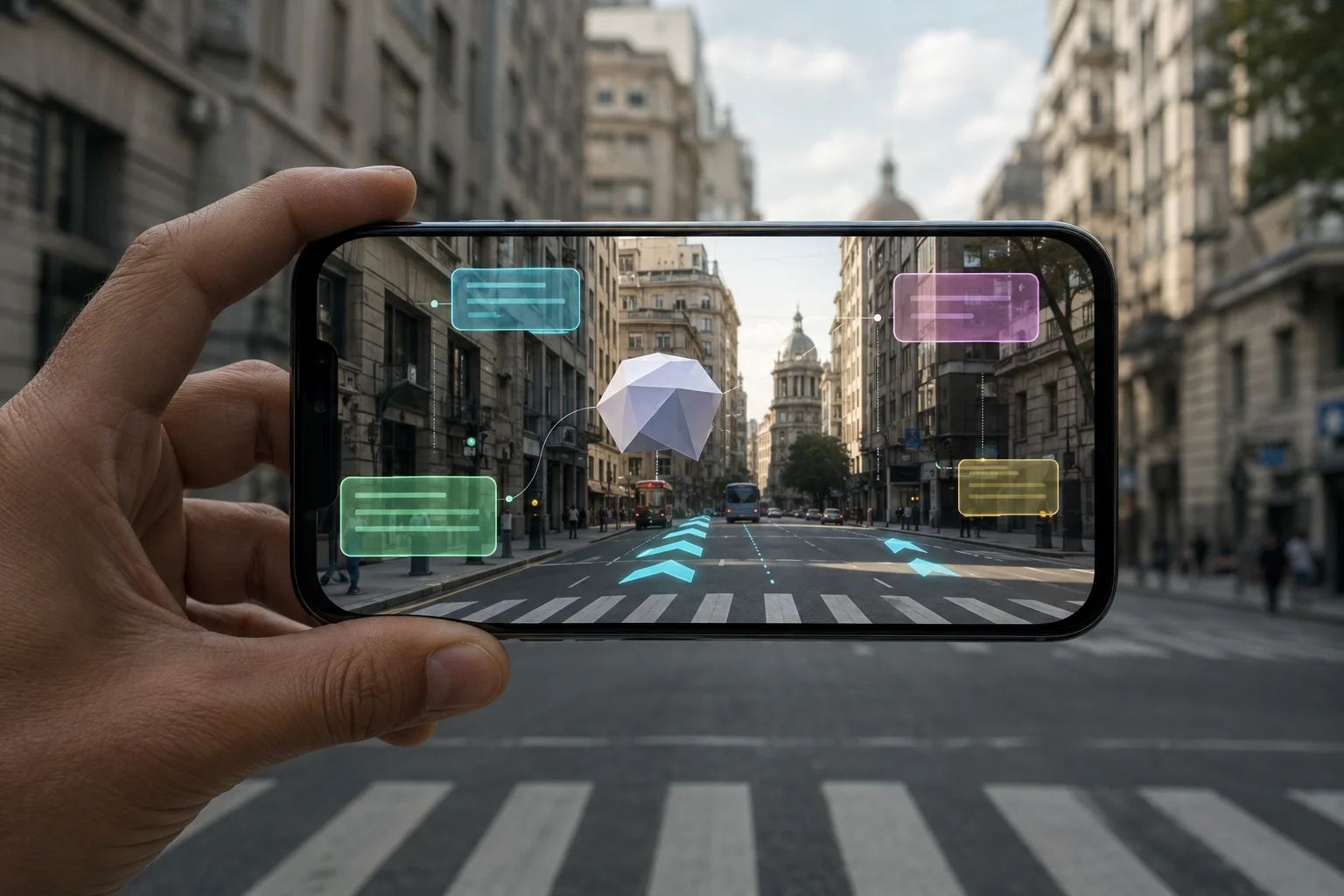
Augmented reality adds digital information on top of the real world instead of replacing it. That's the entire definition. A camera — your phone's today, a pair of glasses some other year — looks at what's in front of you, figures out what it's seeing, and draws something that isn't there. Virtual reality swaps your surroundings for somewhere else entirely; AR leaves the room exactly where it is and writes on top of it. If the acronym soup around this (MR, XR) is what brought you here, the full breakdown lives in our cornerstone guide.
You've almost certainly used it this week. Dog ears in the Snapchat camera, or one of Instagram's built-in effects, are augmented reality doing its most trivial job: finding your face, tracking where you move it, and pasting graphics there frame by frame. Instagram's catalogue got thinner in January 2025, when Meta shut down its Spark platform and every effect made by outside creators vanished overnight, but the house-made ones stayed. Pokémon GO turned ten in July 2026 and still works the way it did on day one. If you've ever come out of a subway exit facing the wrong way and turned on the walking arrows in Google Maps — the feature that launched as Live View and now surfaces as Lens — you pointed your camera at the street and watched a giant arrow hover over the sidewalk. Point an iPhone's Measure app at a table and it hands you the dimensions without a tape measure. All of that is AR. None of it required buying anything.
The hard part isn't drawing the object. Any game engine from 2005 could draw a Pikachu. The hard part is keeping it nailed to the same square metre of pavement while you walk around it. Your phone does that by fusing camera frames with the gyroscope and accelerometer several dozen times a second, picking out distinctive points in the scene — a table corner, a crack in the tile — and building a rough map of the space it can re-recognise as you move. That's what ARKit on iPhone and ARCore on Android actually are. Pro iPhones and iPads add a LiDAR scanner that measures distance directly, which is why they're better at putting a virtual chair behind your real sofa instead of on top of it. When the digital object suddenly slides across the floor, that map lost track of where it was.
Away from the toys, the technology is doing serious work. In spine surgery, the Augmedics xvision system — the first AR guidance platform cleared by the FDA — projects a 3D model of the patient's own anatomy into the surgeon's line of sight, so they can place screws while looking at the patient rather than at a monitor across the room. The company reports more than 13,000 patients and over 71,500 pedicle screws across 26 US states, with published series showing 97-100% placement accuracy. Factories use the same idea more cheaply: assembly instructions pinned to the machine, and a remote expert who can draw an arrow on a technician's live camera feed. That corner of the market took a hit when Microsoft ended HoloLens 2 production in 2024 and confirmed its exit from AR hardware in 2025, leaving enterprise software looking for someone else's headset to run on.
Which brings us to the honest part. The glasses in the advertising — slim, ordinary-looking, holograms floating over the kitchen table — are not a normal thing you can buy. Meta's Ray-Ban Display, at US$799, is a small screen in the right lens showing messages and directions, not holograms; it's been US-only since September 2025, sold in person by appointment, and Meta paused its UK, France, Italy and Canada rollout in January 2026 with no new date. IDC put first-quarter 2026 sales at roughly 15,000 units. Snap went further and shipped actual see-through AR: Specs opened preorders on 16 June 2026 at US$2,195, arriving this autumn in three countries, with a 51-degree field of view and about four hours of battery. Real, impressive, and priced like a used car. Meanwhile the glasses that genuinely sell — Ray-Ban Meta, from US$379 — have no display at all, and in Latin America only Mexico gets them officially.
So the verdict cuts against the marketing: augmented reality isn't the future, it's been in your pocket for a decade. The glasses are the part that isn't ready. If what you actually want is digital objects in your living room today, the device that does it is a passthrough headset, and that's a different question — one our quiz answers in about a minute.
Answer 7 quick questions and find the headset that fits you in 60 seconds.
Take the VR Finder quiz →Prices and specifications are subject to change. See our Privacy Policy.